A weekly review is a fixed 30-minute meeting where the team reads the past seven days from what was recorded, picks out the problems that keep coming back, and settles every open action: closed, re-dated or dropped. It ends with a short list of actions for next week, each with an owner and a date, so the loops opened during the week get closed instead of piling up.
The numbers → the repeats → the boards → open actions → next week's few
Why weekly
Daily meetings deal with today: who is short, what broke, what to do this shift. They are the wrong place to see patterns. A wrapper that stops once on Monday is bad luck. The same wrapper stopping on three days out of five is a problem worth a proper fix, and you only see it when you look at the week as a whole.
In the Plan-Do-Check-Act cycle that W. Edwards Deming taught, the weekly review is the "check"
and "act": look at what happened against what was planned, and decide what to change. The poster
says what it should feel like: The Friday meeting should read the week, not reconstruct
it.
Before the meeting: one page
Bring the week on a single page, built from what was recorded, not from memory:
- The numbers: audits run and what they found, actions raised and closed, minutes of downtime and how many stops.
- The repeats: what came back more than once, biggest first.
- The boards: each shift's result against target, from the hour-by-hour board and the SPQDC board.
- Where the time went: downtime grouped by cause, from the downtime log.
Two poster rules apply here. Every number on the page comes from something captured during
the week.
And A quiet week prints as a quiet week. The page never decorates.
A zero is
an answer; don't hide it, and don't pad around it.
A 30-minute agenda
| Minutes | Item | What happens |
|---|---|---|
| 0–5 | The numbers | Read the page aloud. No discussion yet. |
| 5–12 | The repeats | The top two or three. Decide which need a 5 Whys or an A3. |
| 12–20 | The boards | Each shift's result. The worst day and why. |
| 20–27 | Open actions | Each one: close it, re-date it with a reason, or drop it. |
| 27–30 | Next week | Three actions at most, each with an owner and a date. |
The minutes are start and end times within the meeting. The five slots last 5, 7, 8, 7 and 3
minutes, and 5 + 7 + 8 + 7 + 3 = 30. Keep the order. The repeats come before the boards because,
as the poster puts it, A problem that came back twice outranks a problem that was loud
once.
A worked example
Here is an illustration: a week on a packing line with one day shift, Monday to Friday, and a target of 450 cartons a shift (seven full hours at 60 cartons, plus 30 for the hour with lunch in it: 7 × 60 + 30 = 450).
| Day | Target | Actual | Attainment |
|---|---|---|---|
| Monday | 450 | 415 | 92.2% |
| Tuesday | 450 | 438 | 97.3% |
| Wednesday | 450 | 450 | 100.0% |
| Thursday | 450 | 391 | 86.9% |
| Friday | 450 | 446 | 99.1% |
| Week | 2,250 | 2,140 | 95.1% |
- Attainment is actual ÷ target × 100. Monday: 415 ÷ 450 = 0.922, so 92.2%. Tuesday: 438 ÷ 450 = 97.3%. Wednesday: 450 ÷ 450 = 100.0%. Thursday: 391 ÷ 450 = 86.9%. Friday: 446 ÷ 450 = 99.1%.
- Week target: 5 shifts × 450 = 2,250.
- Week actual: 415 + 438 + 450 + 391 + 446 = 2,140.
- Week attainment: 2,140 ÷ 2,250 = 0.951, so 95.1%. The week was 2,250 − 2,140 = 110 cartons short.
Because every day had the same target, the average of the five daily figures gives the same answer: 92.2 + 97.3 + 100.0 + 86.9 + 99.1 = 475.5, and 475.5 ÷ 5 = 95.1%. When targets differ from day to day, add up the actuals and the targets instead of averaging percentages.
The downtime log shows 9 stops and 88 minutes: the wrapper 5 stops and 52 minutes, labels 3 stops and 21 minutes, and a forklift breakdown once, for 15 minutes (52 + 21 + 15 = 88, and 5 + 3 + 1 = 9). At one carton a minute, the 88 minutes of stops explain 88 of the 110 missing cartons; the other 110 − 88 = 22 came from slow running.
The forklift was the loudest event of the week, and everyone remembers it. But it happened once. The wrapper stopped five times, on three different days, so it leads the repeats. The team decides on a 5 Whys on the film snapping, with maintenance owning it, and asks the Thursday lead to bring the hour-by-hour board to explain the 59-carton gap (450 − 391 = 59).
Open actions: 12 raised this week and 9 closed. Each of the open ones is closed, re-dated or dropped in the room, and the meeting ends with three actions for next week, each with an owner and a date.
Common mistakes
- Skipping it in a busy week. A busy week is the one with the most to learn. Put it in your leader standard work at a fixed time.
- Reconstructing the week from memory. Memory remembers the loud events, not the repeats.
- Turning it into status reports. Each person talking through their week fills 30 minutes and closes nothing.
- Leaving with ten actions. Three that get done beat ten that get carried. Ideas that don't make the cut can go on a PICK chart; a problem too big for a week goes on an A3.
- Never checking last week's actions. Then the review is just a meeting.
A free weekly review poster
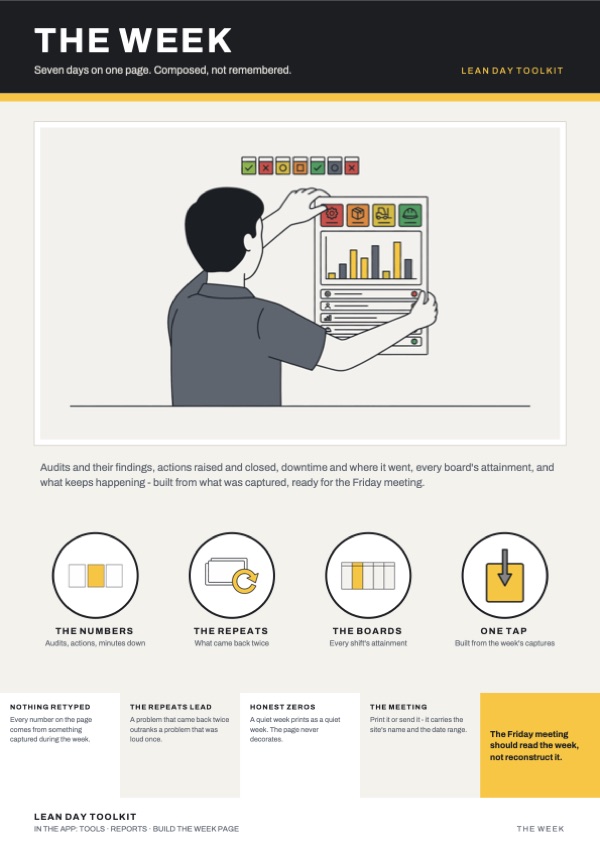
The Week poster puts the four parts of the week page and four rules on one A4 page. It is free to download and print, and it is one of 19 free lean posters.
The weekly review in Lean Day Toolkit
Lean Day Toolkit builds the week page under Tools → Reports → Build the week page, in the full version of the app. It covers the seven days ending today, whatever weekday the meeting is. The page shows audits run and their findings, actions raised and closed, high-priority actions still open, downtime minutes and stops grouped by where the time was lost, waste and ideas captured, red days on the daily board, what keeps happening, and each hour-by-hour board's attainment. It prints as one A4 page carrying your site's name, ready to print or share for the meeting. The action list, where next week's actions are tracked, stays free.