Leader standard work is a short, written list of the checks a supervisor or team leader does every shift, in the same order, at roughly the same times, and ticks off as done. It covers the board, the floor, the audit, the actions and the handover, and everyone can see whether it happened. The point is that the people who run the process keep a standard too, not just the people doing the work.
Why leaders need standard work
Operators work to standard work instructions. Supervisors usually work to whatever the day throws at them. The urgent pushes out the routine, and the routine is what keeps the urgent from happening: the board that nobody reviewed, the missed audit, the action that didn't move for a week.
David Mann's book Creating a Lean Culture describes leader standard work as one of the main elements of a lean management system, alongside visual controls and daily accountability. The idea is simple: the things that keep a lean system working have to be done on purpose, by someone, on a schedule, or they quietly stop being done.
The Lean Day Toolkit poster puts it in one line: What the leader does daily is the
only standard the floor believes.
A sample daily routine for a supervisor
This is the supervisor's daily routine from Lean Day Toolkit's leader standard work pack, with times added for an 06:00 to 14:00 shift. Adjust it to your shift, but keep it short.
| When | Check | Minutes |
|---|---|---|
| 06:00 | Walk the shift start: the right people in the right places, absences covered | 10 |
| 06:10 | Review yesterday on the SPQDC board and mark today's letters | 5 |
| 06:15 | Check that every open action from yesterday has an owner and has moved | 5 |
| 09:00 | Walk the floor once without a clipboard and ask one operator what is in their way | 15 |
| 10:30 | Run today's layered process audit at the point of work | 10 |
| Each hour | Hour-by-hour board up to date, with a reason written for every missed hour, in the hour it missed | 8 × 1 = 8 |
| 12:30 | Every downtime event has the fix that got it running, not just a duration | 5 |
| 13:45 | Write the handover: what happened, what is open, what the next shift must watch | 10 |
Add it up: 10 + 5 + 5 + 15 + 10 + 8 + 5 + 10 = 68 minutes. On a 480-minute shift that is 68 ÷ 480 = 14% of the day. The other 86% is still free for the work that turns up. A routine much longer than this one tends to be the first thing dropped on a busy day.
Each check links to a tool you probably already use: the SPQDC board at the start, a short gemba walk mid-morning, the hour-by-hour board and the downtime log through the shift.
How to write your own
- List what has to happen every shift for the area to run well. Not everything a supervisor does, only the things that stop happening when nobody owns them.
- Write each one as something you can check. "Every missed hour has a reason" can be checked. "Keep an eye on production" can't.
- Put them in order and give each a time. The same order every day becomes a habit.
- Keep it to one page and about an hour. Eight checks is plenty.
- Add a weekly layer for managers. A manager's weekly routine checks a sample of the supervisor's: did the boards get reviewed, did the audits run, were the handovers written? That is what layered audits mean in practice: each level checks that the level below is doing its checks.
Keeping it going: the calendar
A routine that nobody checks fades within a few weeks. The simplest way to keep it is a calendar where each day goes green when the routine was done and red when it wasn't, visible to the team.
The poster's example is Done four of five this week, and everyone can see which day
slipped.
Four of five is 4 ÷ 5 = 80%. Over a month the same counting works: if 18 of 21
working days were done, that is 18 ÷ 21 = 86%. The number matters less than the red days.
Look at what was happening on each one. If Fridays are always red, the routine doesn't fit
Fridays, and the routine should change, not the supervisor's willpower.
The handover is part of the routine
The last check is the one most often skipped, and the one the next shift notices most. A written handover answers three questions: what happened, what is still open, and what the next shift must watch. Write it before you leave, not from the car park. Five lines is enough.
Common mistakes
- Making it a list of everything. Twenty checks guarantee red days. Start with six or eight.
- Ticking without doing. If the manager's weekly layer never looks behind the ticks, the ticks stop meaning anything.
- Treating red days as failures of the person. Treat them like any other miss: ask why the process allowed it. A short 5 Whys works here too.
- Walking with a clipboard. The floor walk in the routine is for listening. Write down what you heard afterward, not during.
A free leader standard work poster
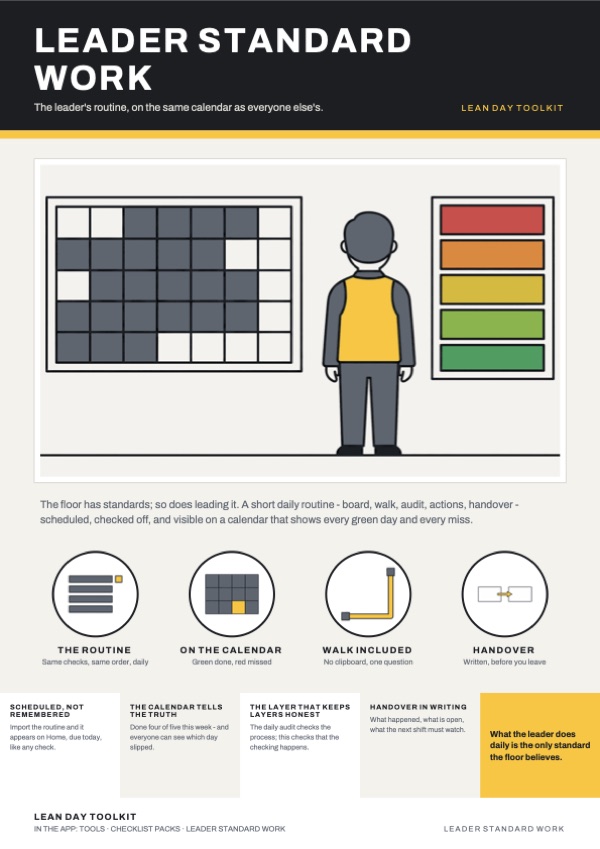
The Leader Standard Work poster has the four steps, the routine, on the calendar, walk included and handover, on one A4 page. It is free to download and print, and it is one of 19 free lean posters.
Leader standard work in Lean Day Toolkit
Lean Day Toolkit has leader standard work as a checklist pack under Tools → Checklist packs, in the full version of the app. There are two leader standard work packs: a supervisor daily routine, which is the eight checks above in three sections, and a manager weekly routine. Each check is marked pass or fail. Once imported, the routine appears on Home when it is due, like any other scheduled check. Each checklist has a month calendar that shows which days were done and which were missed, with a count such as "18 of 21" for the month.