A gemba walk is going to the place where the work is done, to see it for yourself and to ask the people doing it. Gemba is Japanese for "the actual place". A walk is not an inspection or a tour. The point is to understand how the work really happens, which is often different from how the report says it happens, and to come away with a few things worth fixing.
Before you go
- Pick a purpose. One question is enough: "Why are we short on Fridays?" or "What gets in the way at the packing bench?" A walk with no question tends to turn into a chat.
- Pick a route that follows the work. Follow the product or the order, from goods in to goods out, not the layout of the departments.
- Tell the team. Say you are coming to learn, not to check up on anyone. Then act like it.
- Keep it short. Twenty or thirty minutes, done regularly, beats a long walk once a quarter.
What to look at
- Waiting. People, machines or material standing still.
- Piles. Work in progress building up between steps shows where the flow breaks.
- Walking and searching. Someone fetching tools or looking for parts.
- Workarounds. Taped labels, handwritten notes, a "special" way of doing a step. Each one is a problem someone has already solved for themselves.
- The visual standards. Are the boards up to date? Do the floor markings, the 5S standards and the SPQDC board match what is actually happening?
- Safety. Blocked walkways, missing guards, anything that made you step around it.
The eight wastes make a good checklist to carry in your head.
What to ask
Ask the person doing the job. As the poster says, The person at the bench knows things no
report contains.
Questions that open people up:
- "Can you show me how this step works?"
- "What gets in your way most days?"
- "What happens when this goes wrong?"
- "If you could change one thing here, what would it be?"
Ask, don't tell. If you see something wrong, ask why it happens rather than handing out a fix on the spot. The answer usually points at the process, not the person.
Close the walk
A walk that ends as a memory is soon forgotten. Before you leave the floor, write down what you saw and pick the few things worth acting on, each with an owner. Thank the people you talked to, and tell them later what happened to what they said. That is what makes them talk next time.
A free gemba walk poster
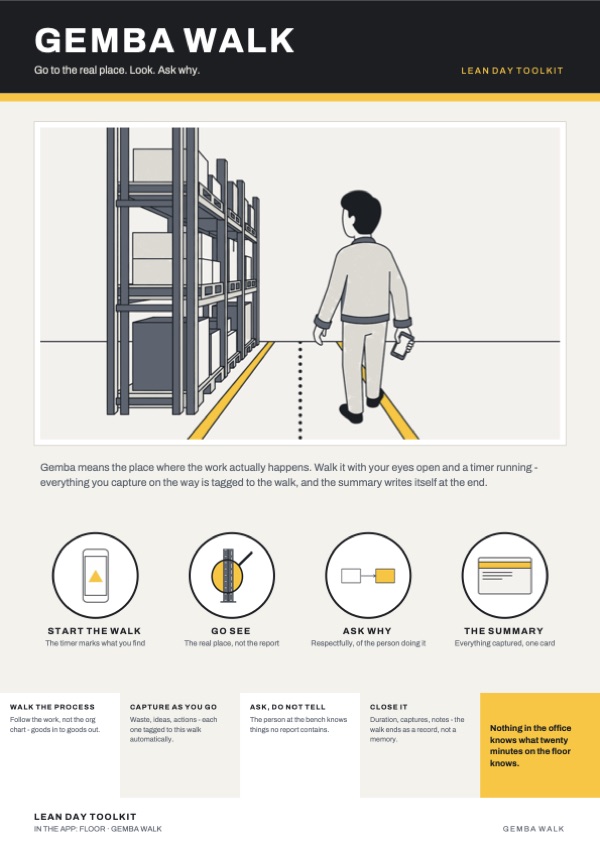
The Gemba Walk poster has the four steps
and four rules on one A4 page, ending with Nothing in the office knows what twenty minutes on
the floor knows.
It is free to download, print and use in your own workplace, and it is one of
19 free lean posters.
Gemba walks in Lean Day Toolkit
Lean Day Toolkit has gemba walks under Floor → Gemba walk, in the full version of the app. You start the walk and a timer runs; the waste, ideas and actions you capture on the way are tagged to that walk automatically; and when you close it, the duration, captures and notes end up on one summary card, so the walk ends as a record.