In lean, waste is anything the customer would not pay for. The eight wastes are the kinds that turn up on almost every floor, and the usual way to remember them is the word DOWNTIME: Defects, Overproduction, Waiting, Non-utilized talent, Transportation, Inventory, Motion and Extra-processing. The first seven come from the Toyota Production System; non-utilized talent was added later.
The eight wastes
| Waste | What it is | What it looks like |
|---|---|---|
| Defects | Work that is wrong and has to be scrapped, fixed or checked again | A mislabeled pallet found at dispatch; a rework bench that is never empty |
| Overproduction | Making more, or sooner, than the next step needs | Cartons packed for an order that ships next week |
| Waiting | People or work standing still | An operator watching a machine cycle; a truck waiting for paperwork |
| Non-utilized talent | Ideas and skills nobody asks for | The person who knows why the jam happens, never asked |
| Transportation | Moving material that doesn't need to move | Parts carried across the building twice between two steps |
| Inventory | More stock or work-in-progress than the flow needs | Racks of half-finished work hiding a slow station |
| Motion | People moving more than the job needs | Walking to a shared tool, bending to a low shelf, searching for a scanner |
| Extra-processing | Doing more than the customer asked for | Wrapping a pallet twice; a report nobody reads |
Why overproduction is the one to watch
Overproduction is often called the worst of the eight because it creates the others: the extra product has to be moved (transportation), stored (inventory), and counted and searched for (motion). It also hides problems. A line that builds ahead never has to show that one station can't keep up. Making to the customer's pace, takt time, is the main defense against it.
How to start seeing waste
- Name it. Put the eight names somewhere everyone can see them. People can't report what they have no word for.
- See it. Walk the floor with the list (a gemba walk) and look for one waste at a time. Fifteen minutes looking only for motion finds more than an hour looking for "problems".
- Log it. Write down the type, the place and how bad it was, while you're standing there. Ten seconds is enough.
- Rank it. After a few weeks, sort the log. A Pareto chart shows the few wastes that keep coming back. Fix the biggest first.
The Lean Day Toolkit poster ends on this line: The worst waste is the one nobody has named
yet.
A free eight wastes poster
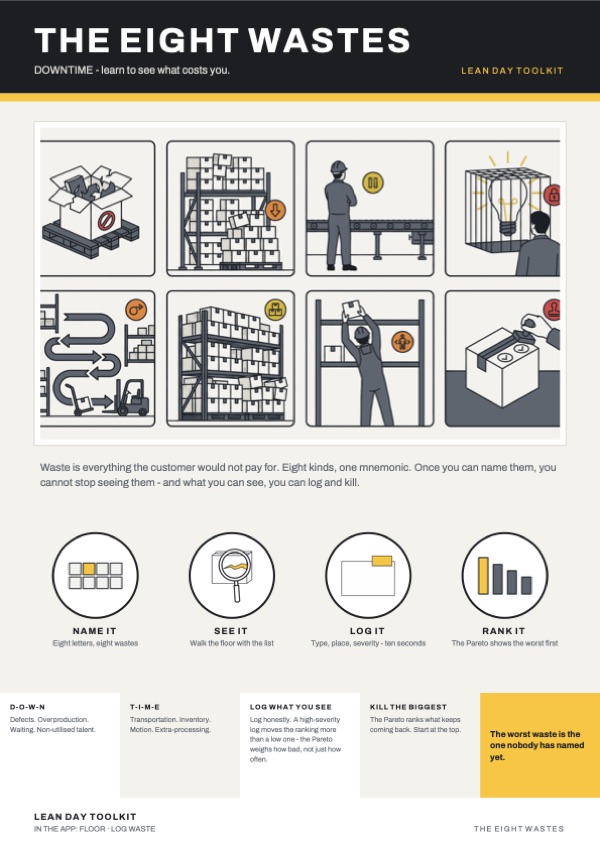
The Eight Wastes poster shows all eight with the DOWNTIME mnemonic on one A4 page. It is free to download, print and use in your own workplace, and one of 19 free lean posters.
Logging waste in Lean Day Toolkit
In Lean Day Toolkit, Floor → Log waste records the type, place and severity in a few taps, and a Pareto chart ranks what keeps coming back. A high-severity log moves the ranking more than a low one, so the chart weighs how bad a waste is, not just how often it happens.