Takt time is the pace your work has to run at to meet customer demand, and nothing faster. You get it by dividing the production time you actually have by the number of units the customer needs in that time. The word comes from the German Takt, a beat in music, which is a good way to think of it: the drumbeat the floor works to.
Takt time = available production time ÷ customer demand
A worked example
A packing line runs one eight-hour shift and has to ship 850 cartons a day.
- Start with the shift: 8 hours is 480 minutes.
- Take out the planned breaks: they add up to 45 minutes. That leaves 435 minutes, or 26,100 seconds.
- Divide by demand: 26,100 seconds ÷ 850 cartons = 30.7 seconds.
The line needs to finish a carton about every 31 seconds. If a second shift starts and the order doubles to 1,700 cartons, the arithmetic is the same: 52,200 seconds ÷ 1,700 cartons is still 30.7 seconds. Takt only changes when the ratio of time to demand changes.
Why faster than takt is not better
It is tempting to read takt as a target to beat. It isn't one. A line that runs at 25 seconds a carton when takt is 31 builds about 190 extra cartons a shift that nobody has ordered yet: they take up floor space, tie up material and hide problems. Running slower than takt builds a queue and a late shipment. The goal is to be on the beat.
The Lean Day Toolkit poster puts it in one line: Takt is not how fast you can go. It is
how fast you must.
Takt time vs cycle time
The two get mixed up because they are measured in the same units.
| Takt time | Cycle time | |
|---|---|---|
| What it is | The pace the customer needs | How long the job actually takes |
| Where it comes from | Calculated: time available ÷ demand | Measured: a stopwatch at the job |
| What changes it | Demand or available time | The way the work is done |
You compare them. If the measured cycle time of a step is longer than takt, that step can't keep up and the work piles up in front of it. If it is much shorter, the step waits, and there may be room to balance work across fewer people or stations. Measure real cycles at the job, several of them, rather than using the number in the system.
Three mistakes that make takt wrong
1. Leaving the breaks in
Use the time the line can actually run: the shift minus breaks, meetings and planned stops. Using the full 480 minutes in the example gives 33.9 seconds, and the line falls behind every day without anyone knowing why.
2. Taking out unplanned downtime too
Breakdowns and waiting for parts are problems to fix, not part of the plan. Leave them in the available time. If you subtract them, takt quietly gets shorter every time something goes wrong and the losses disappear from view. Track them separately, with a downtime log or OEE.
3. Calculating it once
Demand moves, so takt moves. Recalculate when the order book changes, at least whenever you plan the week. Yesterday's pace is not today's.
A free takt poster for the board
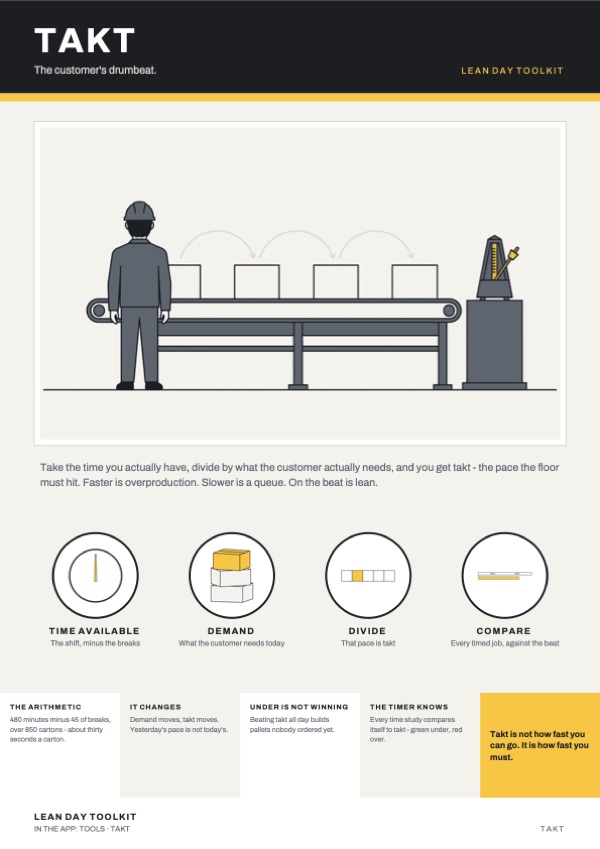
The Takt poster walks through the four steps, time available, demand, divide and compare, on one A4 page with this same carton example. It is free to download, print and use in your own workplace. It is one of 19 free lean posters, alongside the Time Study and OEE posters that go with it.
Takt in Lean Day Toolkit
Lean Day Toolkit has a takt calculator under Tools → Takt, and it is one of the tools that stays free. Every time study in the app compares itself to takt, green under and red over, so the comparison above happens as you time the job.