A3 problem solving means working through one problem on a single sheet of paper, in seven boxes: background, current condition, target, root cause, countermeasures, plan and follow-up. The left side says what is true now, the right side says what will change, who will do it and by when. The one-page limit is the point. If the story won't fit, the problem isn't understood yet.
Background → current condition → target → root cause | countermeasures → plan → follow-up
Where it comes from
The A3 comes from Toyota, and it is named after the paper size it was written on: A3 is 297 × 420 mm, about the size of two letter sheets side by side. John Shook's book Managing to Learn (Lean Enterprise Institute, 2008) describes how Toyota uses it to teach problem solving, not just to report it. The layout follows Plan-Do-Check-Act: the left half is the Plan, the right half is Do, Check and Act.
The seven boxes
Left side: the story
- Background. Why this problem is worth the time, and who it hurts. Two or three lines.
- Current condition. What is happening now, in numbers: measured, photographed, dated. No causes and no fixes yet. If there is no number here, nothing can prove the fix worked later.
- Target. The same number, where you want it, by a date. "Improve delivery" is not a target.
- Root cause. Why the gap between the current condition and the target exists. Keep asking why until you reach something you can change. A 5 Whys chain fits here.
Right side: the plan
- Countermeasures. What you will change, and which cause each change removes. Call them countermeasures, not solutions: you are testing a change.
- Plan. One line per task: task, owner, date.
Every line becomes a tracked action carrying its name,
as the poster puts it. - Follow-up. Did the number move? Set the check date before you start, and write the result on the page, good or bad.
A worked example
This is an illustration: late shipments from a warehouse packing area.
1. Background
The packing area ships about 660 orders a week. Customers have complained twice this month about late deliveries, and late orders cost extra calls and re-promised dates.
2. Current condition
Over the last four weeks, 2,650 orders shipped and 212 of them were late. 212 ÷ 2,650 = 0.08, so 8.0% of orders were late. The reasons, from the shipping log:
- Missed the afternoon truck: 131
- Short of stock: 44
- Label or address problem: 23
- Other: 14
Check: 131 + 44 + 23 + 14 = 212. Missing the truck is 131 ÷ 212 = 62% of the late orders, so this A3 is about the truck.
3. Target
Below 2% late within eight weeks. At the current volume, 2% of 2,650 orders is 53 late orders over four weeks.
4. Root cause
- Why did orders miss the truck? They were still being packed when it left at 16:00.
- Why were they still being packed? Half the day's orders reached packing at 14:30, all at once.
- Why all at once? The system releases orders in two waves, at 07:00 and 14:30.
- Why 14:30? The wave times were set when the truck left at 18:00. The carrier moved the pickup to 16:00 last year, and nobody changed the release times.
5. Countermeasures
- Release orders every hour instead of in two waves, so packing works at a steady pace and the last release is well before the truck. (Removes the batch release.)
- Add "check order release times" to the checklist used when a carrier changes its pickup. (Removes the reason nobody noticed.)
Short stock and labels are real problems too, but they have different causes. They get their own A3s rather than being squeezed onto this one.
6. Plan
- Set order release to hourly — Dana — 14 Nov
- Brief both packing shifts on the new release — Luis — 15 Nov
- Add release times to the carrier-change checklist — Priya — 21 Nov
- Count late orders by reason, weekly — Luis — every Friday
7. Follow-up
Four weeks after the change, 2,710 orders shipped and 61 were late. 61 ÷ 2,710 = 0.0225, so 2.3% were late, down from 8.0%. Missed trucks fell from 131 to 9, which is 122 fewer, or 93% (122 ÷ 131 = 0.93).
The target of below 2% was not met, and the page says so. Of the 61 late orders, 61 − 9 = 52 had other causes, mostly short stock. The countermeasure worked on its own cause. The next A3 starts from the stock shortages.
Four rules that keep an A3 honest
- Facts, not opinions.
The current condition is measured, photographed, dated.
- One page is the discipline. The poster says it bluntly:
An appendix is a confession.
- Fill the left side first. Writing countermeasures before the current condition has numbers in it is the most common way an A3 goes wrong.
- Close the loop.
The follow-up box is why an A3 beats a slide deck - it comes back to check.
A free A3 poster for the board
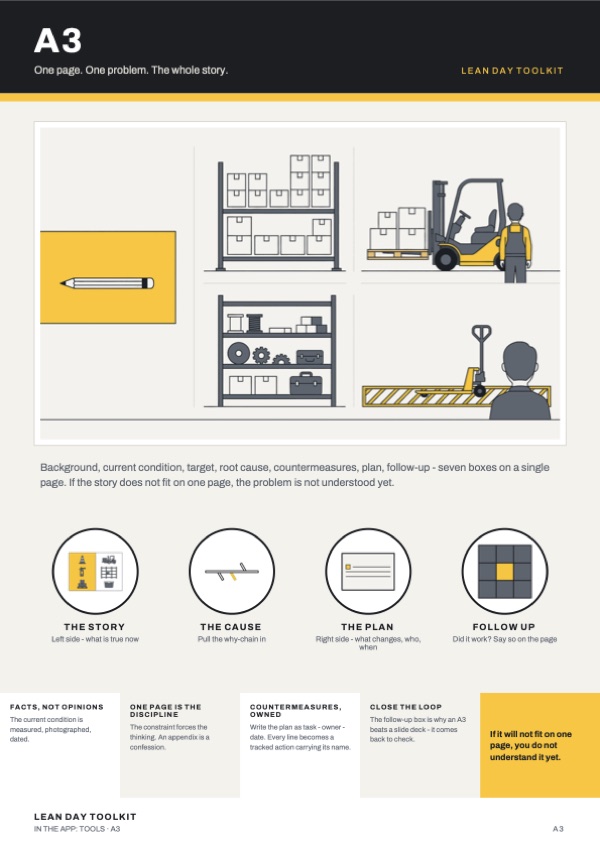
The A3 poster puts the four steps, the story,
the cause, the plan and follow up, on one A4 page, ending with If it will not fit on one
page, you do not understand it yet.
It is free to download and print, and it is one of
19 free lean posters. The
5 Whys poster covers the root cause
box.
A3 in Lean Day Toolkit
Lean Day Toolkit has A3 under Tools → A3, which is part of the full version. Each A3 has the same seven sections, and a completion meter split down the middle shows how much of the left and right halves you have filled. Every section has a short hint and a warning, such as the reminder that a target needs a number and a date. The root cause section can pull in a 5 Whys chain you have already run. "Send plan to actions" turns each line of the plan into an action on the action list, taking the name after the dash as the owner. The finished A3 exports as a PDF on one landscape page.