A shift handover the next shift actually uses is short, factual and starts with what they have to act on: safety, the numbers, what stopped the work, and what is still open, each open item with a name and a date on it. Write it from what was recorded during the shift, not from memory at the end, and walk the incoming lead through it at the board as well as handing over the page.
Safety → the numbers → what stopped us → what is still open → what to do first
Why most handovers get ignored
Most handover notes are written in the last ten minutes of a long shift, from memory, by someone who wants to go home. They come out as a story ("busy day, wrapper played up, got most of it out") or as a list of everything that happened. Neither tells the incoming lead what to do in their first hour, so they stop reading, and the one line that mattered gets lost.
That line can matter a great deal. Lord Cullen's public inquiry into the 1988 Piper Alpha disaster in the North Sea found that information about a pump taken apart for maintenance on the day shift did not reach the night shift properly, and the night shift tried to start it. The UK Health and Safety Executive (HSE) covers shift handover in its guidance on safety-critical communication. Most handovers are far less serious, but the failure is the same: what the next shift needed was in someone's head, or in the middle of a paragraph.
The five parts of a handover that gets used
- Safety. Anything that could hurt someone on the next shift: a guard off, a spill, a near miss, a permit still open. If there is nothing, write "nothing". An empty box looks forgotten.
- The numbers. Target, actual and the gap for the shift, on one line.
- What stopped the work. Each stop, how long it lasted, and the cause as far as you know it.
- What is still open. Every problem you didn't finish, written as an action with an owner and a date.
- What to do first. One or two things the incoming lead should do or check in their first hour.
That fits on one page, and it should. If it doesn't, the extra is probably story.
A worked example
Here is a day shift on a packing line, 06:00 to 14:00. It is an illustration. The line packs one carton a minute when it is running, so each hour's target equals its planned minutes: 60 cartons for a full hour, and 30 for the hour with the half-hour lunch in it. The lead kept an hour-by-hour board as the shift went.
| Hour | Planned minutes | Target | Actual | Gap | Why |
|---|---|---|---|---|---|
| 06–07 | 60 | 60 | 58 | −2 | |
| 07–08 | 60 | 60 | 61 | +1 | |
| 08–09 | 60 | 60 | 42 | −18 | Film snapped twice, wrapper down 15 min |
| 09–10 | 60 | 60 | 59 | −1 | |
| 10–11 | 30 | 30 | 30 | 0 | Lunch, 30 min |
| 11–12 | 60 | 60 | 60 | 0 | |
| 12–13 | 60 | 60 | 48 | −12 | Label roll ran out, waited 10 min |
| 13–14 | 60 | 60 | 57 | −3 | |
| Shift | 450 | 450 | 415 | −35 |
How to read it:
- Planned minutes is the time the hour actually has: 60, less any planned break.
- Target is planned minutes × 1 carton a minute.
- Actual is the count keyed in at the end of each hour.
- Gap is actual minus target.
- The shift row adds up the hours. Planned minutes and target: seven full hours × 60 = 420, plus 30 for the lunch hour, = 450. Actual: 58 + 61 + 42 + 59 + 30 + 60 + 48 + 57 = 415. Gap: 415 − 450 = −35.
Where did the 35 go? Hours 08–09 and 12–13 lost 18 + 12 = 30 cartons. The two stops account for 15 + 10 = 25 of those, at one carton a minute, and the slow restart after each stop for the other 5. The remaining hours were a net 5 short (−2 + 1 − 1 − 3 = −5). So 25 + 5 + 5 = 35.
The handover written from that board:
| Safety | Film offcuts on the floor by the wrapper, cleared 13:40. No injuries, no near misses. |
|---|---|
| Numbers | 415 cartons against a target of 450: 35 short. |
| Stops | Wrapper, 15 min from 08:20: film snapped twice. Labels, 10 min from 12:15: roll ran out, no spare at the line. |
| Open | Wrapper tension: Priya (maintenance) to check the setting by Thursday. Spare label roll: Dave to add one to the line-side kit before 14:30 today. |
| First | Watch the wrapper on the first heavy pallet. Check the spare label roll is on the rack. |
Notice what is not there: no adjectives, no "busy day", nothing the next lead can't act on or check. If the film keeps snapping, that is a job for a 5 Whys, and the downtime log will show whether it does.
Say it at the board, too
A page alone is easy to skim. Spend five minutes with the incoming lead at the board, walk
through the sheet, and let them ask questions. That conversation becomes the first item of their
start-of-shift meeting, the one the poster describes as Ten minutes at the board - what hurt
yesterday, what the plan is today, and who is covering what.
If your area runs an
SPQDC board, the safety line of the handover is the first
letter of the day.
Four habits that make it work
1. Write it during the shift
Key each hour in that hour, and note each stop when it happens. The poster puts it this way:
A shift judged at the end is a story. An hour keyed in the hour is a fact you can still do
something about.
The handover is then mostly copying.
2. Give every open item a name and a date
Every stop and every miss leaves as an action with a name and a date, or the shift repeats
itself tomorrow.
"Wrapper needs looking at" is a wish. "Priya, tension setting, Thursday" is
an action someone can check.
3. Use the same format every shift
Same five headings, same order, every time. The reader learns where to look, and a missing part stands out.
4. Start by reading back yesterday's open items
Close what was done and carry the rest. An item carried for three shifts in a row goes up a level, with the number, what was tried and what is needed. A regular check of carried items is a good line for your leader standard work.
A free shift poster for the board
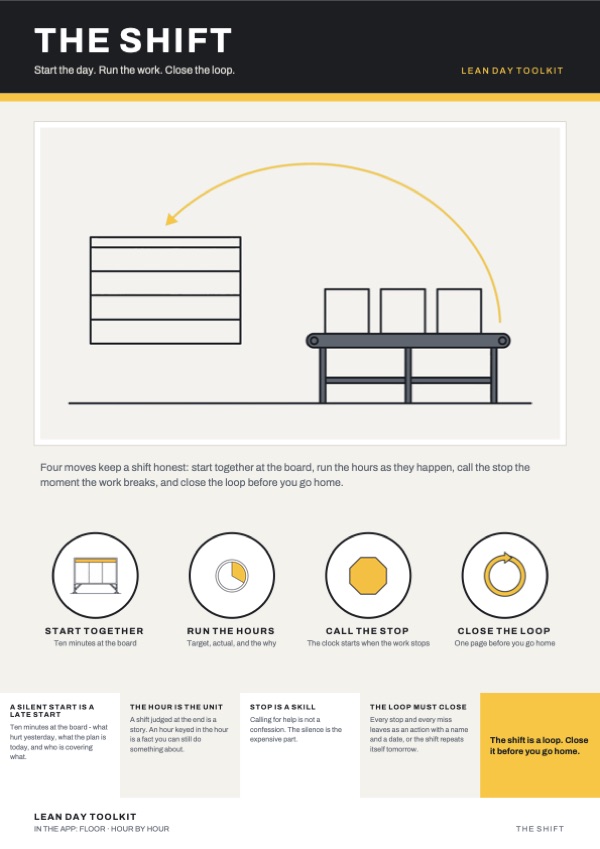
The Shift poster puts the four moves,
start together, run the hours, call the stop and close the loop, on one A4 page, ending with
The shift is a loop. Close it before you go home.
It is free to download and print, and it
is one of 19 free lean posters.
Shift handovers in Lean Day Toolkit
Lean Day Toolkit has an hour-by-hour board under Floor → Hour by hour, in the full version of the app. Each hour has its own planned minutes, 60 unless a break takes some away, a target and an actual, and the app asks why only when the target was missed. One button builds the shift report so far, or the end-of-shift report once every hour is in, as a single A4 page you can share. The report is built from what was already captured: the board, the downtime log, the audits, the actions raised and closed, the waste captured during the shift, and the answers to the shift's questions, such as headcount or rework. The action list, where the open items live, stays free.