A time study means standing at a job with a stopwatch, timing several real cycles, and working out the average, the best and the worst. You then compare that average with takt time, the pace the customer needs, to see whether the job can keep up. It needs a stopwatch, a pencil and about twenty minutes. The answer is often different from the number in the system, and that difference is the point.
Watch → time 10 cycles → average, best, worst → compare with takt
Why time it yourself
Standard times in a planning system get typed in once and rarely checked. Memory is worse:
ask three people how long a job takes and you get three answers. The Lean Day Toolkit poster
puts it this way: Not what the system says. Not what anyone remembers.
Timing work with a stopwatch goes back to Frederick Winslow Taylor's studies in the late 1800s and early 1900s. Formal work measurement, done by industrial engineers, goes further: it rates how fast the operator was working and adds allowances to set a standard time. You don't need that to run a line well. A floor time study answers a simpler question: how long does this job really take today, and is that fast enough?
How to do a time study, step by step
1. Pick one job
One task, one place, real work. "Pack a carton at bench 2" is a job. "Packing" is not. Tell the person doing it what you are doing and why: you are timing the job, not them.
2. Watch first
Watch two full cycles before you start the stopwatch. Decide exactly where a cycle starts and ends, for example "hand touches the empty carton" to "carton lands on the conveyor". If you change the start and end points halfway through, the numbers stop meaning anything.
3. Time the cycles
Time at least ten cycles in a row. Ten laps beat one guess,
as the poster says: one
cycle can be lucky or unlucky, and ten show you what normally happens. Write down anything
unusual next to the lap it happened in: a dropped carton, a question from a colleague, a roll
change.
4. Work out the spread
Calculate the average, and note the best and worst laps. All three are true. A wide spread is a finding in its own right: it means the job is not stable yet, and the average alone hides that.
5. Compare with takt
Takt time is the time available divided by customer demand. If the average is under takt, the job can keep up. If it is over, the customer is waiting. There is a full walk-through in how to calculate takt time.
A worked example
This is an illustration, using the packing line from the takt article.
The takt
- One shift of 8 hours is 480 minutes.
- Take out 45 minutes of planned breaks: 480 − 45 = 435 minutes.
- 435 minutes × 60 = 26,100 seconds.
- Demand is 850 cartons: 26,100 ÷ 850 = 30.7 seconds per carton.
The ten laps
A team leader times ten cartons at the packing bench, in seconds:
28 · 30 · 29 · 31 · 27 · 30 · 48 · 29 · 28 · 30
Lap 7 has a note beside it: "changed the film roll".
- Add them up: 28 + 30 + 29 + 31 + 27 + 30 + 48 + 29 + 28 + 30 = 310 seconds.
- Average: 310 ÷ 10 = 31.0 seconds.
- Best and worst: 27 seconds and 48 seconds, a spread of 21 seconds.
- Against takt: 31.0 is 0.3 seconds over 30.7. On the face of it, the bench can't keep up.
What the slow lap means
One lap is far slower than the rest, so look at it before deciding anything. Without lap 7:
- 310 − 48 = 262 seconds over nine laps.
- 262 ÷ 9 = 29.1 seconds.
- The other nine run from 27 to 31 seconds, a spread of only 4 seconds.
- 29.1 is 1.6 seconds under takt, about 5% of headroom (1.6 ÷ 30.7 = 0.052).
So which number is true? It depends on the note. If the roll change was a one-off, leaving it out is fair, and the bench runs comfortably under takt. But if a roll lasts about ten cartons, the roll change is part of the job and belongs in the average. Then 31.0 seconds is the honest number, and over a shift it adds up: 26,100 ÷ 31.0 = 841.9, so the bench finishes 841 cartons, 9 short of the 850 needed.
That turns the study into a specific problem. The roll change costs about 19 extra seconds (48 − 29 = 19). If staging rolls at the bench cut 10 seconds from it, lap 7 would take 38 seconds, the ten laps would add up to 300 seconds, and the average would be 300 ÷ 10 = 30.0 seconds, back under takt.
Common mistakes
- Timing too few cycles. With three laps, one odd one moves the average a lot. Time ten or more before you trust the result.
- Throwing away slow laps without asking why. A slow lap that happens every few cycles is part of the job. Leave it out only if it really was a one-off, and say that you did.
- Timing the fastest person. Time the job as it is usually done, by the person usually doing it.
- Treating faster than takt as the goal. Under takt is enough. Much faster than takt usually means waiting or overproduction somewhere else.
- Timing once and filing it. Re-time after any change to the job, and whenever takt changes.
A free time study poster for the board
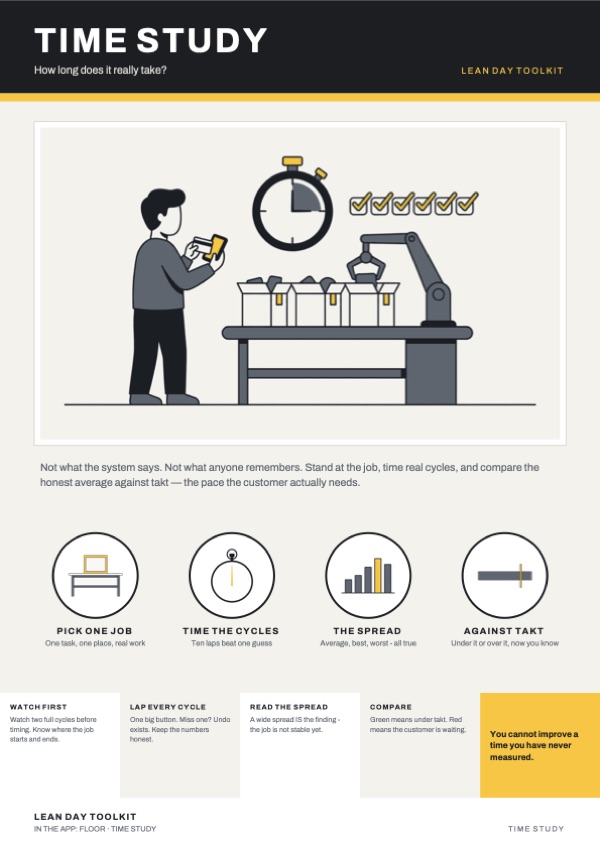
The Time Study poster puts the four
steps, pick one job, time the cycles, the spread and against takt, on one A4 page, ending with
You cannot improve a time you have never measured.
It is free to download and print, and
it is one of 19 free lean posters, alongside the
Takt poster that goes with it.
Time studies in Lean Day Toolkit
Lean Day Toolkit has a stopwatch time study under Floor → Time study, and the stopwatch and its results are among the tools that stay free. You tap one large button for each lap, and a lap tapped by mistake can be undone. The result shows the average, the shortest and longest lap and the standard deviation, with a green "Under takt" or red "Over takt" badge against the takt from the app's takt calculator. Laps well above the usual are marked and left out of the takt verdict, and the result says how many were left out and which average it judged. With fewer than ten laps, it says the verdict is a rough first look. When a job is over takt, one tap raises it on the action list, and the study can be exported as a PDF. Step-by-step element studies are part of the full version.