A near miss is something that nearly hurt someone or nearly broke something, but didn't. When the number of near misses reported goes up, it usually means people have started to trust that speaking up gets something fixed, not that the site has become more dangerous. Each report is a warning that arrived before the accident. The job of a supervisor is to make reporting easy, read the count honestly, and make sure every report leads somewhere.
It almost happened → one sentence → where → the count → one action
What counts as a near miss
OSHA and the National Safety Council describe a near miss as an unplanned event that caused no injury, illness or damage but could have. The UK's Health and Safety Executive uses much the same idea. In plain words: nothing broke, but it nearly did.
Some everyday examples:
- The top pallet on a stack shifted when a truck braked, and nobody was under it.
- A forklift came round a blind corner as someone stepped out of an aisle.
- A box cutter was left open on a packing bench at hand height.
- A guard was found unlatched on a machine that was about to start.
The test is simple: if the timing had been a little different, would someone be filling in an accident report instead? If yes, it is a near miss and worth one sentence.
Why a rising count is usually good news
Most near misses are never reported. The pallet shifts, someone says "that was close", and the shift carries on. The hazard is still there tomorrow. So when a site starts reporting properly, the count goes up, because it is measuring what was always happening and was never written down.
The Lean Day Toolkit poster puts it this way: The site with zero near misses is not the
safe one. It is the quiet one.
A count of zero usually tells you that people don't think
reporting is worth the bother, or worry it will come back on them.
There is a long tradition behind the idea that small events point to big ones. H. W. Heinrich, in his 1931 book Industrial Accident Prevention, argued that serious injuries sit on top of a much larger number of minor incidents and near misses. His exact ratios have been widely questioned since, so don't quote them as a law. The useful part holds up: the near misses show you where the serious accident is likely to happen, while you still have time to act.
A worked example
Here is an illustration from a warehouse that started taking near misses seriously.
- Before: 2 near misses reported in a month, both by the same team leader.
- First month of easy reporting: 11 reported.
- Second month: 17 reported. That is 15 more than before, or about eight and a half times as many (17 ÷ 2 = 8.5).
- Where they were: of the 17, 10 were at the loading dock, 4 in the picking aisles and 3 at the packing benches. That is 10 + 4 + 3 = 17, so every report had a place.
Nothing about the dock changed between the first month and the second. What changed is that people said so. Ten of seventeen at one spot (10 ÷ 17 = 59%) is a clear signal: that is where the next fix belongs, and where a serious injury was most likely to happen first.
When a rising count is not good news
Be honest about the other possibility. If the same hazard is reported week after week and nothing changes, the count is rising because the problem is getting worse or because nobody is fixing it. Look at what is being reported, not only how many. A healthy count rises, then the repeats at any one spot fall as the fixes land.
Make reporting take one sentence
People report when it is quick, safe and useful. The poster's four steps cover all three.
1. The moment
Nothing broke; it nearly did. Ask for the report as soon after the moment as possible, while the details are clear.
2. Say it once
One sentence, in the words used at the time: No forms, no grades, no blame.
A long form
with severity scores and root-cause boxes turns a thirty-second report into a fifteen-minute
chore, and most people will skip it. You can investigate the serious ones afterward.
3. Say where
Name the area or the machine, so the fix lands in the right place. "Near the dock door" is enough. Where is what lets you see clusters like the one in the example.
4. The fix
Every report needs a visible answer. A serious one becomes an action with an owner and a date. Even a small one gets a reply at the next huddle: "We saw it, here's what we did." People stop reporting when reports disappear.
Keep it about the process, not the person
A near miss report that leads to someone being told off is the last one that person will write. Ask what made the situation possible: the blind corner, the stacking height, the missing mirror. If the answer is "someone wasn't paying attention", ask one more question: what would have caught it even if they weren't? The 5 Whys works well for the serious ones.
How to read the count each week
- Look at a rolling period. The last 30 days smooths out a busy week.
- Look at the places. Several reports at one area or machine point to the next fix.
- Look at the repeats. The same hazard reported again means the last fix didn't work, or never happened.
- Thank people at the huddle. Say the number out loud and what was done about the biggest one. That is what keeps the count rising.
Don't set a target to reduce near miss reports. A target to bring the number down is a target to stop people reporting, and it will be met.
A free near miss poster for the board
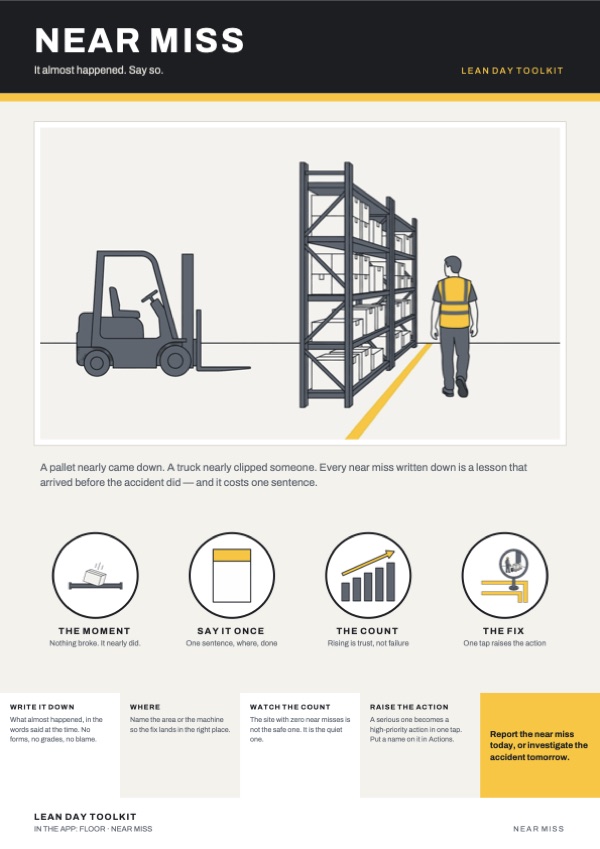
The Near Miss poster puts the four steps,
the moment, say it once, the count and the fix, on one A4 page, ending with Report the near
miss today, or investigate the accident tomorrow.
It is free to download and print, and it
is one of 19 free lean posters.
Near miss reports in Lean Day Toolkit
Lean Day Toolkit has near miss reports under Floor → Near miss, and they are one of the tools that stay free. You tap "It almost happened", write one sentence and, if you like, pick the area it happened in. The screen shows how many were reported in the last 30 days, with the reminder that rising is trust, not failure. One tap on a report raises it as a high-priority action on the action list, where you can put a name on it.